
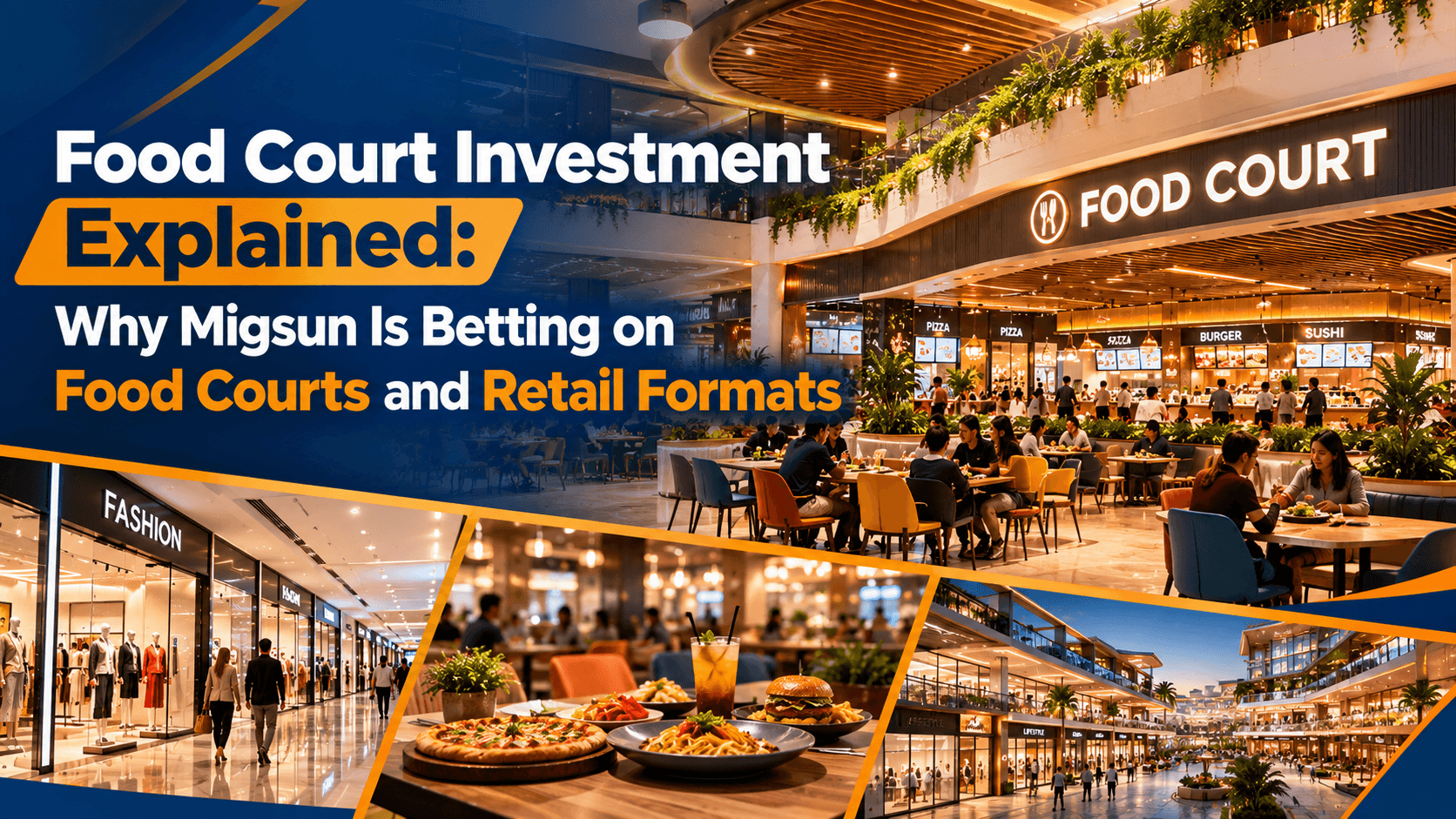
Commercial real estate is evolving rapidly as consumer preferences, urban lifestyles, and business requirements continue to change. While traditional retail shops and office spaces remain important investment options, food courts are emerging as an attractive format for investors looking to participate in the growing food and beverage (F&B) sector.
From shopping malls and commercial complexes to mixed-use developments, food courts have become an essential part of modern retail planning. They bring together dining, leisure, convenience, and social experiences under one roof. For property investors, this creates an opportunity to explore commercial real estate investment through a format that combines consumer demand with strategically planned retail infrastructure.
Migsun Group has been incorporating food courts and diverse retail formats into its commercial developments, including projects such as Migsun Lucknow Central and Migsun Alpha Central in Greater Noida. These developments reflect a broader approach to commercial real estate, where shopping, dining, business, and entertainment are designed to complement one another.
But what makes food court investment different from traditional commercial property investment? Why are developers focusing on food courts? And what should investors evaluate before purchasing a food court space?
This guide explains the concept of food court investment, its potential benefits, associated risks, and the factors that make location, footfall, tenant mix, and project planning essential to a successful commercial property decision.
What Is Food Court Investment?
Food court investment refers to purchasing a commercial unit or designated space within a food court development with the intention of generating rental income, operating a food business, or benefiting from potential long-term property appreciation.
Unlike a conventional retail shop, which may serve a single business category, a food court is designed to accommodate multiple food and beverage operators in a shared dining environment.
These spaces may include:
- Quick-service restaurants
- Cafés and beverage outlets
- Fast-food counters
- Dessert and bakery outlets
- Regional cuisine outlets
- Casual dining concepts
- Established food brands
- Independent food entrepreneurs
A food court typically provides shared seating, common circulation areas, and supporting facilities. This format allows customers to choose from different food options without visiting multiple standalone establishments.
For investors, food court spaces can represent an entry point into commercial real estate without requiring them to operate a restaurant themselves. Depending on the ownership and leasing structure, the property owner may lease the unit to a food operator and receive rent under an agreed contract.
However, rental income is not automatic. It depends on factors such as location, tenant demand, occupancy, lease terms, operating conditions, and the overall performance of the development.
Why Are Food Courts Becoming Popular in Commercial Real Estate?
Food courts have gained importance because modern consumers increasingly view dining as part of their shopping, entertainment, and social activities.
A visit to a commercial destination may involve shopping, meeting friends, watching a movie, working, or enjoying a meal. Food courts support these activities by offering multiple dining options in a convenient environment.
Several factors contribute to the growing interest in food court developments.
Changing Consumer Preferences
Consumers increasingly look for variety, convenience, and comfortable dining experiences. A food court allows visitors to explore different cuisines and price points in one location.
This flexibility can appeal to families, students, working professionals, shoppers, and groups with different food preferences.
Growth of Organised Retail
Modern retail developments are increasingly designed as experience-led destinations rather than places focused only on shopping.
Food courts complement retail shops by encouraging visitors to spend more time within a commercial complex. A customer who visits for shopping may also dine, meet friends, or participate in leisure activities.
This creates opportunities for different businesses to benefit from shared customer traffic.
Urbanisation and Growing Commercial Hubs
As cities expand, new residential neighbourhoods, office districts, educational institutions, and healthcare facilities create demand for organised food and retail spaces.
A well-planned food court located near these activity centres may serve multiple customer groups throughout the day.
Convenience and Choice
A food court offers multiple food options within a single destination. Customers can choose according to their budget, taste, and time constraints.
This convenience is particularly useful in mixed-use developments where people may already be visiting for shopping, work, or other activities.
Opportunities for Food Entrepreneurs
Food courts can provide a structured environment for entrepreneurs who want to establish or expand their food businesses.
Compared with a standalone restaurant, a food court may offer access to shared infrastructure and an existing commercial environment. Actual operating costs and benefits, however, depend on the unit, lease arrangement, fit-out requirements, and management policies.
Why Is Migsun Focusing on Food Courts and Retail Formats?
Migsun Group’s commercial development approach includes a mix of retail, dining, office, and other commercial formats. The inclusion of food courts reflects the importance of creating destinations that serve multiple consumer needs.
Rather than treating a commercial building as a collection of isolated shops, integrated retail planning can bring together different activities that support one another.
For example:
- Retail outlets attract shoppers.
- Food courts provide dining options.
- Office spaces bring working professionals.
- Entertainment facilities encourage longer visits.
- Shared amenities support customer convenience.
When these elements are planned effectively, they can contribute to a more active commercial environment.
Migsun’s projects, including Migsun Lucknow Central and Migsun Alpha Central, incorporate food and retail spaces as part of broader commercial offerings.
The underlying idea is that food courts can complement retail and office activity, creating a destination where visitors have multiple reasons to arrive and spend time.
For investors, this makes it important to assess the entire development rather than focusing only on the food court unit. The surrounding retail mix, accessibility, parking, tenant profile, and project management can all influence the property’s commercial prospects.
Food Court Investment vs Traditional Retail Shop Investment
Investors often compare food court spaces with conventional commercial shops. Both formats can offer opportunities for rental income and long-term ownership, but their business models and operating requirements differ.
| Factor | Food Court Space | Traditional Retail Shop |
|---|---|---|
| Primary use | Food and beverage businesses | Retail or service businesses |
| Customer activity | Dining-led visits | Product or service-led visits |
| Shared facilities | Often includes common seating and dining areas | Depends on the development |
| Tenant mix | Restaurants, cafés, and food brands | Fashion, electronics, services, and other retailers |
| Customer experience | Focuses on dining and convenience | Focuses on shopping or services |
| Footfall drivers | Dining demand, office traffic, retail activity | Location, visibility, product demand |
| Operating requirements | May involve specialised ventilation, utilities, and food-related approvals | Depends on the tenant’s business |
| Investment considerations | Tenant demand, food court management, leasing terms | Retail demand, frontage, visibility, and lease terms |
Neither format is automatically better for every investor.
A traditional shop may suit someone seeking exposure to a particular retail market, while a food court unit may appeal to an investor interested in dining-led commercial activity.
The right choice depends on the project’s location, purchase price, lease structure, operating expenses, and the investor’s financial objectives.
The Importance of Location in Food Court Investment
Location is one of the most important factors influencing the performance of any commercial property.
For food courts, location affects customer accessibility, repeat visits, tenant interest, and the potential for sustained business activity.
A food court may have attractive interiors and modern facilities, but its commercial prospects can be limited if customers find it difficult to reach or if the surrounding area lacks sufficient demand.
Before investing in a food court, evaluate the following location factors.
Residential Catchment
Nearby residential communities can provide a recurring customer base, especially during evenings, weekends, and holidays.
A food court serving a growing residential area may benefit from local demand for casual dining, takeaway food, and family outings.
Office and Business Districts
Working professionals can contribute to weekday demand, particularly during lunch breaks and after office hours.
Food courts near business districts may attract employees seeking convenient dining options.
Educational Institutions
Colleges, universities, and coaching centres can create demand for affordable food and beverages.
However, investors should examine the actual student population, accessibility, spending patterns, and operating hours of nearby institutions.
Healthcare Facilities
Hospitals and medical centres can generate activity from healthcare workers, patients’ families, and visitors.
Food options near healthcare facilities may serve a different customer profile from those in entertainment-focused retail destinations.
Road Connectivity and Public Transport
Easy access by road, metro, public transport, and pedestrian routes can influence the number of visitors a commercial development attracts.
Parking availability and entry points are also important, particularly for family dining and group visits.
Visibility and Wayfinding
A food court should be easy for visitors to locate within the commercial complex.
Clear signage, convenient lifts, escalators, and circulation routes can influence whether customers discover and use the dining area.
Migsun Lucknow Central: Food Court and Retail Opportunities
Migsun Lucknow Central is a commercial development in Sushant Golf City, Lucknow, offering retail shops, food court spaces, and commercial studios.
The project is positioned along the Sultanpur Road and Shaheed Path corridor, with proximity to Medanta Hospital and other urban destinations. Its food court offering is designed to complement the wider commercial environment.
The project is registered under UP RERA number UPRERAPRJ589752/04/2024. Buyers should consult the official regulatory record for the latest project details and declared completion information.
Why the Location Matters
Sushant Golf City is a developing urban area with residential, commercial, healthcare, and recreational activity.
A commercial food court in such an environment may serve different visitor categories, including:
- Nearby residents
- Office employees
- Retail customers
- Healthcare workers and visitors
- Families
- Students and other local consumers
The presence of multiple customer groups can diversify potential demand. However, actual footfall will depend on project completion, occupancy, tenant mix, accessibility, and the development of the surrounding area.
Integrated Commercial Planning
Migsun Lucknow Central combines food court spaces with retail and studio offerings.
This integrated format can create opportunities for visitors to combine activities such as shopping, dining, and business-related visits.
For investors, it is worth examining how the food court connects with other parts of the development. The location of the unit, floor level, visibility, access, and proximity to shared facilities may influence its suitability for different food operators.
What Investors Should Verify
Before purchasing a food court unit, buyers should obtain clarity on:
- Exact unit location and carpet area
- Total acquisition cost
- Applicable taxes and additional charges
- Food court operating rules
- Utility provisions
- Ventilation and exhaust arrangements
- Common-area maintenance
- Leasing conditions
- Possession and handover terms
- Applicable approvals and project documentation
A site visit and a review of the complete cost sheet can help buyers understand the investment more accurately.
Migsun Alpha Central: Combining Retail, Dining, and Business
Migsun Alpha Central in Greater Noida is another example of a commercial development that brings together retail, business suites, and food-related spaces.
The project is positioned in Greater Noida, with access to the Alpha and Delta metro station areas and connectivity to important parts of the city.
Its mixed commercial format reflects a planning approach in which dining is considered alongside shopping and business activity.
Why Mixed-Use Commercial Developments Matter
A commercial destination with multiple uses may attract visitors for different reasons and at different times of the day.
For example:
- Office users may visit during working hours.
- Retail customers may arrive during afternoons and weekends.
- Food court visitors may come during lunch and dinner periods.
- Business meetings may generate additional activity.
- Entertainment and leisure offerings may encourage longer visits.
This diversity can support the overall appeal of a commercial destination, although it does not guarantee occupancy or investment returns.
Evaluating Food Court Spaces in Greater Noida
Investors considering a food court in Greater Noida should examine the surrounding residential population, office demand, transport access, competing food outlets, and the project’s commercial positioning.
The presence of infrastructure or planned development in a region can influence long-term prospects, but investors should distinguish completed infrastructure from proposed projects and future expectations.
A practical assessment should focus on current accessibility, actual customer demand, and the project’s own execution status.
How Food Court Investment Can Generate Rental Income
One of the main reasons investors explore commercial property is the possibility of recurring rental income.
A food court unit may be leased to a restaurant operator, café, or other food business under a mutually agreed contract.
The rental structure can vary depending on the property, tenant, and agreement. It may include a fixed rent, a revenue-linked component, or a combination of both.
Fixed Rental Model
Under a fixed rental arrangement, the tenant pays an agreed amount at specified intervals.
The investor should carefully review:
- Monthly rent
- Lease duration
- Security deposit
- Rent escalation
- Lock-in period
- Maintenance responsibilities
- Payment dates
- Termination conditions
A signed lease agreement is essential. Project brochures or verbal assurances should not be treated as a substitute for a binding contract.
Revenue-Sharing Model
Some commercial arrangements involve rent linked to a percentage of business revenue.
Such models require clear definitions of gross sales, reporting procedures, audit rights, payment frequency, and other contractual conditions.
Investors should understand how revenue will be verified and what happens if the business underperforms.
Calculating Rental Yield
Rental yield helps investors compare the income potential of different properties.
The basic formula is:
Rental Yield = Annual Rental Income ÷ Total Property Cost × 100
For example, if a commercial unit costs ₹50 lakh and generates ₹3 lakh in annual rent, its gross rental yield would be 6%.
This is only an illustration, not a projected return for any Migsun project.
Investors should also calculate net yield after accounting for maintenance, taxes, insurance, vacancy, brokerage, and other expenses.
Understanding the Role of Footfall in Food Court Performance
Footfall refers to the number of people visiting a commercial location during a given period.
For food courts, footfall is an important business indicator because restaurants depend on customers entering the development and choosing to dine.
However, high footfall alone does not guarantee strong sales or rental performance.
The quality of footfall matters just as much as its volume.
Relevant Customer Traffic
A food court may attract large numbers of visitors, but its performance depends on whether those visitors are interested in purchasing food.
For example, office employees may generate regular lunch demand, while families may contribute more activity during evenings and weekends.
Understanding the customer profile helps investors assess the potential suitability of the location.
Repeat Visits
Repeat customers can support long-term business activity.
Residential communities, workplaces, and educational institutions may contribute to recurring visits when the food court offers suitable pricing, convenience, and variety.
Tenant Mix
A balanced tenant mix can help a food court appeal to different customer groups.
A combination of quick-service outlets, beverages, desserts, and varied cuisines may provide greater choice than a collection of businesses offering similar products.
Accessibility and Comfort
Seating, cleanliness, ventilation, lighting, signage, and circulation influence the dining experience.
These factors may affect customer satisfaction and the willingness of visitors to return.
Investors should therefore consider both the physical design of the food court and the management arrangements responsible for maintaining it.
Key Benefits of Food Court Investment
Food court investment offers several features that may appeal to commercial property buyers.
1. Exposure to the Food and Beverage Sector
Investors can participate in a commercial format linked to dining and food services without necessarily operating a restaurant themselves.
2. Multiple Potential Tenant Categories
Food courts can accommodate different types of food businesses, including cafés, quick-service restaurants, dessert outlets, and regional cuisine brands.
This creates a broader potential tenant pool, although actual demand depends on the project’s location and leasing conditions.
3. Shared Commercial Environment
Food courts benefit from being part of a larger destination that may include retail, offices, and leisure facilities.
Shared customer activity can support the overall commercial environment.
4. Potential for Recurring Rental Income
A leased food court unit may generate periodic rental income under the agreed terms.
Investors should assess tenant quality, lease duration, vacancy risk, and operating expenses before estimating returns.
5. Commercial Property Ownership
Food court investment provides exposure to commercial real estate, which has different demand drivers and operating considerations from residential property.
6. Potential Long-Term Appreciation
Property values may increase when supported by factors such as improved connectivity, rising local demand, effective project management, and sustained commercial activity.
However, appreciation is never guaranteed, and market conditions can change.
7. Diversification
For investors who already hold residential property or other assets, commercial real estate may provide a different source of income and market exposure.
Diversification does not eliminate risk, and investors should consider their overall financial position before purchasing.
Risks of Food Court Investment Every Buyer Should Understand
Despite its potential advantages, food court investment is not risk-free.
Understanding these risks is essential before making a financial commitment.
Vacancy Risk
A unit may remain vacant if suitable tenants are unavailable or existing businesses close.
Vacancy can reduce rental income and increase the owner’s expenses.
Tenant Business Risk
A food operator may struggle because of competition, pricing, management problems, or changing consumer preferences.
Investors should not assume that every tenant will remain financially successful throughout the lease period.
Footfall Risk
Projected footfall may differ from actual visitor numbers.
A development’s commercial performance depends on accessibility, occupancy, tenant mix, marketing, and the surrounding area’s activity.
Operating Cost Risk
Food court spaces may involve maintenance charges, utility expenses, taxes, insurance, and other costs.
These expenses can reduce net returns.
Liquidity Risk
Commercial properties may take time to sell, particularly if the market is weak or the unit has limited tenant demand.
Investors should avoid committing funds they may need urgently.
Regulatory and Documentation Risk
Commercial property transactions involve legal and regulatory requirements. Buyers should verify title, project approvals, RERA details where applicable, permitted use, and contractual obligations.
Market Risk
Rental demand, property prices, and business activity can change due to economic conditions, competition, and consumer behaviour.
A realistic investment assessment should account for both favourable and unfavourable scenarios.
Food Court Investment vs Residential Property Investment
Some investors compare commercial food court spaces with residential apartments.
Both property types can serve different financial and lifestyle objectives.
| Factor | Food Court Investment | Residential Property |
|---|---|---|
| Primary demand | Food businesses and commercial activity | Housing requirements |
| Potential income | Commercial rent | Residential rent |
| Tenant profile | Restaurants and food operators | Individuals and families |
| Operating considerations | Commercial maintenance and food-related infrastructure | Residential maintenance and tenant management |
| Key location factors | Footfall, visibility, business catchment | Employment, schools, transport, and liveability |
| Vacancy considerations | Availability of suitable commercial tenants | Availability of residential tenants |
| Investment horizon | Depends on lease and market conditions | Depends on rental and resale objectives |
| Due diligence | Commercial use, approvals, lease terms | Residential approvals, title, and possession |
The choice should depend on the investor’s goals, available capital, income requirements, and tolerance for risk.
A commercial property should not be selected solely because its advertised rental yield appears higher. The investor must also consider vacancy, operating costs, tenant demand, and resale liquidity.
How to Evaluate a Food Court Property Before Investing
A structured evaluation can help investors compare different food court opportunities.
Step 1: Research the Location
Study the surrounding residential, commercial, educational, and healthcare catchment.
Visit the area at different times to understand accessibility and activity levels.
Step 2: Examine the Project Layout
Review the floor plan and identify the unit’s location, visibility, access, and proximity to common seating and circulation areas.
Step 3: Verify the Legal Documents
Check the project’s RERA registration where applicable, title documents, approvals, and permitted commercial use.
Consult a qualified property lawyer before signing the agreement.
Step 4: Understand the Total Cost
Request a complete cost sheet covering the base price, taxes, registration, maintenance deposits, parking, utility charges, and other applicable expenses.
Step 5: Assess Tenant Demand
Research whether food operators are interested in the location and whether the proposed food court format matches local demand.
Step 6: Review Lease Terms
If rental income is part of the investment plan, understand the lease structure, rent escalation, security deposit, maintenance obligations, and termination clauses.
Step 7: Calculate Realistic Returns
Estimate gross and net rental yield using conservative assumptions.
Account for vacancy periods, operating costs, and potential changes in market rent.
Step 8: Compare Alternatives
Compare the food court unit with other commercial properties in the same market.
Look beyond promotional claims and focus on actual costs, documentation, tenant demand, and project execution.
Step 9: Consider Your Investment Horizon
Commercial real estate may require patience, particularly when purchasing an under-construction property or entering a developing market.
Ensure that the investment timeline aligns with your financial needs.
Why Retail Formats and Food Courts Work Together
Food courts are increasingly considered an important component of integrated retail planning because they can complement other commercial activities.
A retail development that offers only shops may attract visitors primarily for specific purchases. Adding dining and leisure options can create more reasons for people to visit and spend time at the destination.
This does not mean every mixed-use development will succeed. The result depends on the quality of planning, tenant selection, management, and customer experience.
Supporting Retail Activity
Food courts can encourage shoppers to take breaks, meet friends, or extend their visits.
This may benefit surrounding businesses when the commercial environment is planned effectively.
Creating a Destination
A combination of shopping, dining, and entertainment can make a commercial complex more attractive to different customer groups.
The goal is to create a destination that offers convenience and variety rather than relying on a single business category.
Supporting Different Operating Hours
Retail shops, offices, and food outlets may have different peak activity periods.
A well-managed mixed-use development can accommodate these varying patterns and create a more active environment throughout the day.
Improving the Commercial Mix
A balanced tenant mix can help reduce dependence on a single type of business.
However, the success of this approach depends on whether the selected formats match the needs and spending patterns of the surrounding population.
The Future of Food Court Investment in India
The outlook for food court investment will depend on several broader trends in consumer behaviour and commercial real estate.
Experience-Led Retail
Retail developments are increasingly incorporating dining, leisure, and entertainment to create more engaging customer experiences.
Food courts fit naturally into this approach by offering convenience and variety.
Growth of Organised Food Services
As organised food businesses expand, demand may emerge for well-planned commercial spaces that support their operational requirements.
The availability of suitable locations, infrastructure, and leasing terms will influence this demand.
Expansion of Urban Neighbourhoods
Growing cities create new residential and commercial catchments.
Food courts located near these areas may benefit from changing patterns of consumption and convenience-oriented dining.
Integration of Work and Leisure
Mixed-use commercial developments bring workplaces, shopping, and dining closer together.
Food courts can support this environment by providing dining options for employees, visitors, and nearby residents.
Changing Consumer Expectations
Customers increasingly value cleanliness, accessibility, variety, and comfortable environments.
Developers and operators that address these expectations may be better positioned to attract repeat visitors, although performance remains dependent on execution.
For investors, these trends provide useful context, but they should not replace property-specific research or be treated as guarantees of future returns.
Frequently Asked Questions About Food Court Investment
Is food court investment a good option?
Food court investment may suit buyers seeking exposure to commercial real estate and the food and beverage sector. Its suitability depends on location, tenant demand, purchase price, lease terms, operating costs, and the investor’s financial goals.
How does food court investment generate income?
A food court owner may lease the unit to a food operator and receive rent under a contractual arrangement. Income may be fixed or linked to business revenue, depending on the agreement.
What factors influence food court rental income?
Important factors include location, customer catchment, footfall, tenant quality, occupancy, unit visibility, lease terms, and maintenance expenses.
Why are developers including food courts in commercial projects?
Food courts complement retail, office, and leisure spaces by providing dining options within a shared destination. They can help create a more varied commercial environment and support customer convenience.
What should I check before buying a food court unit?
Verify the legal documents, project registration where applicable, total cost, unit location, utility provisions, maintenance charges, lease terms, and realistic tenant demand.
Is food court investment better than buying a retail shop?
Neither option is universally better. Food courts and traditional retail shops serve different business categories and have different operating requirements. Investors should compare specific properties based on cost, demand, risk, and financial objectives.
Can food court property generate passive income?
A leased food court unit may provide rental income without the owner directly operating a food business. However, owners still need to manage lease renewals, tenant issues, maintenance obligations, and other property-related responsibilities.
What are the risks of food court investment?
Key risks include vacancy, tenant business failure, lower-than-expected footfall, operating expenses, legal issues, market changes, and limited resale liquidity.
Why consider Migsun food court projects?
Migsun’s commercial portfolio includes food court and retail formats within developments such as Migsun Lucknow Central and Migsun Alpha Central. Buyers should assess the specific project’s location, documentation, construction status, pricing, and leasing arrangements before making a decision.
Conclusion: Is Food Court Investment Worth Exploring?
Food court investment represents an interesting segment of commercial real estate because it connects property ownership with the everyday demand for dining and convenience.
As retail developments evolve into experience-led destinations, food courts can play an important role in bringing together customers, food businesses, and complementary commercial activities.
For investors, the appeal lies in the possibility of rental income, exposure to commercial property, and participation in a format that supports multiple food operators. However, these opportunities come with risks involving vacancy, tenant performance, operating costs, legal compliance, and market conditions.
Migsun Group’s focus on food courts and integrated retail formats reflects this shift in commercial development. Projects such as Migsun Lucknow Central and Migsun Alpha Central demonstrate how dining spaces can be incorporated into broader commercial environments.
Still, the success of any investment depends on more than the concept. Location, accessibility, actual footfall, tenant demand, construction quality, documentation, and financial terms must all be evaluated carefully.
Before investing in a food court property, research the market, inspect the project, understand the complete cost, and seek independent legal and financial advice.
A well-informed commercial property decision begins with understanding not only the potential opportunity but also the risks, responsibilities, and conditions that determine its long-term performance.
Disclaimer
This article is intended for general informational and marketing purposes only. Property prices, availability, approvals, project status, rental income, and market conditions may change. Food court investments involve financial and operational risks, and returns are not guaranteed. Buyers should verify all details through official sources, review applicable legal documents, and seek independent professional advice before making an investment decision.